In Search of Light 2

By
Miguel Gonzalez
Where
MAD Arts
Where
Dania Beach
/
MAD Arts

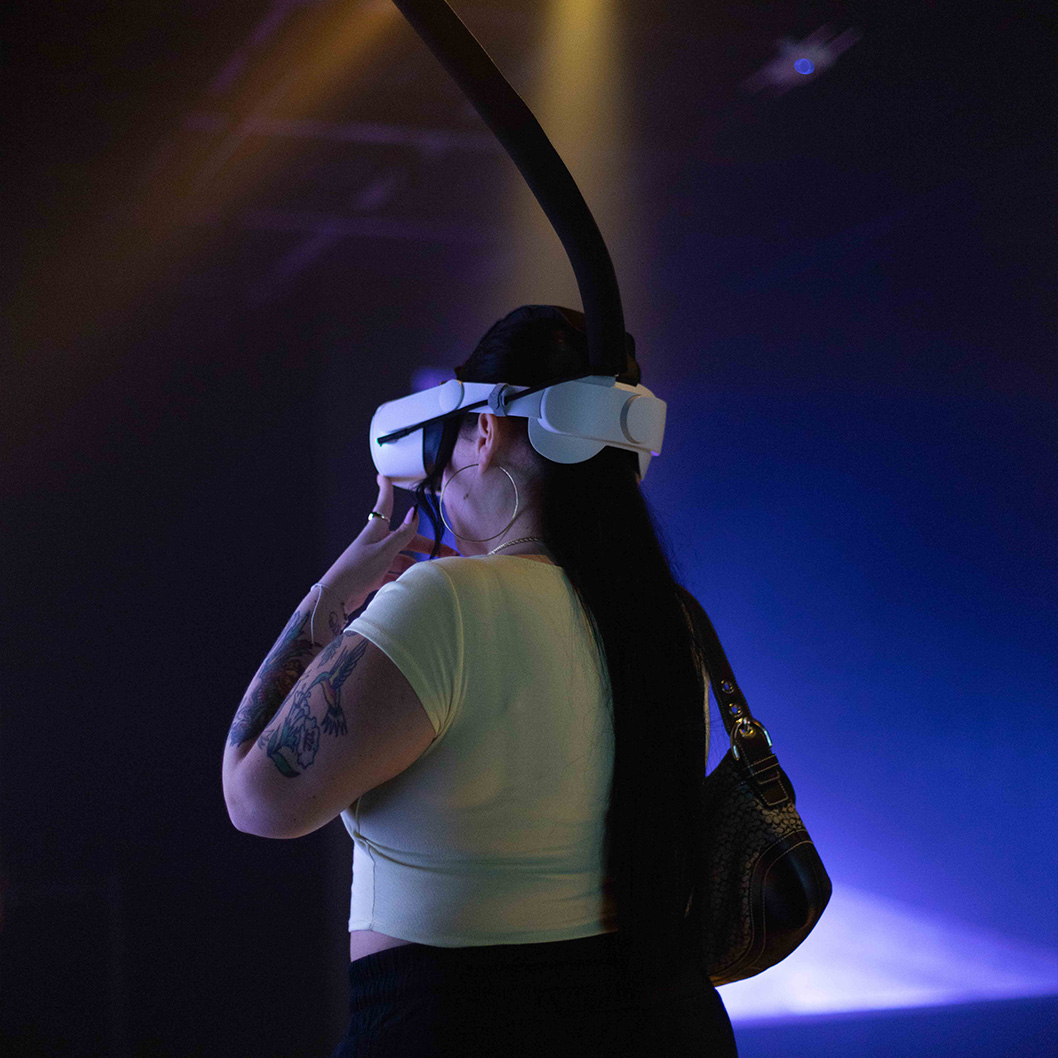
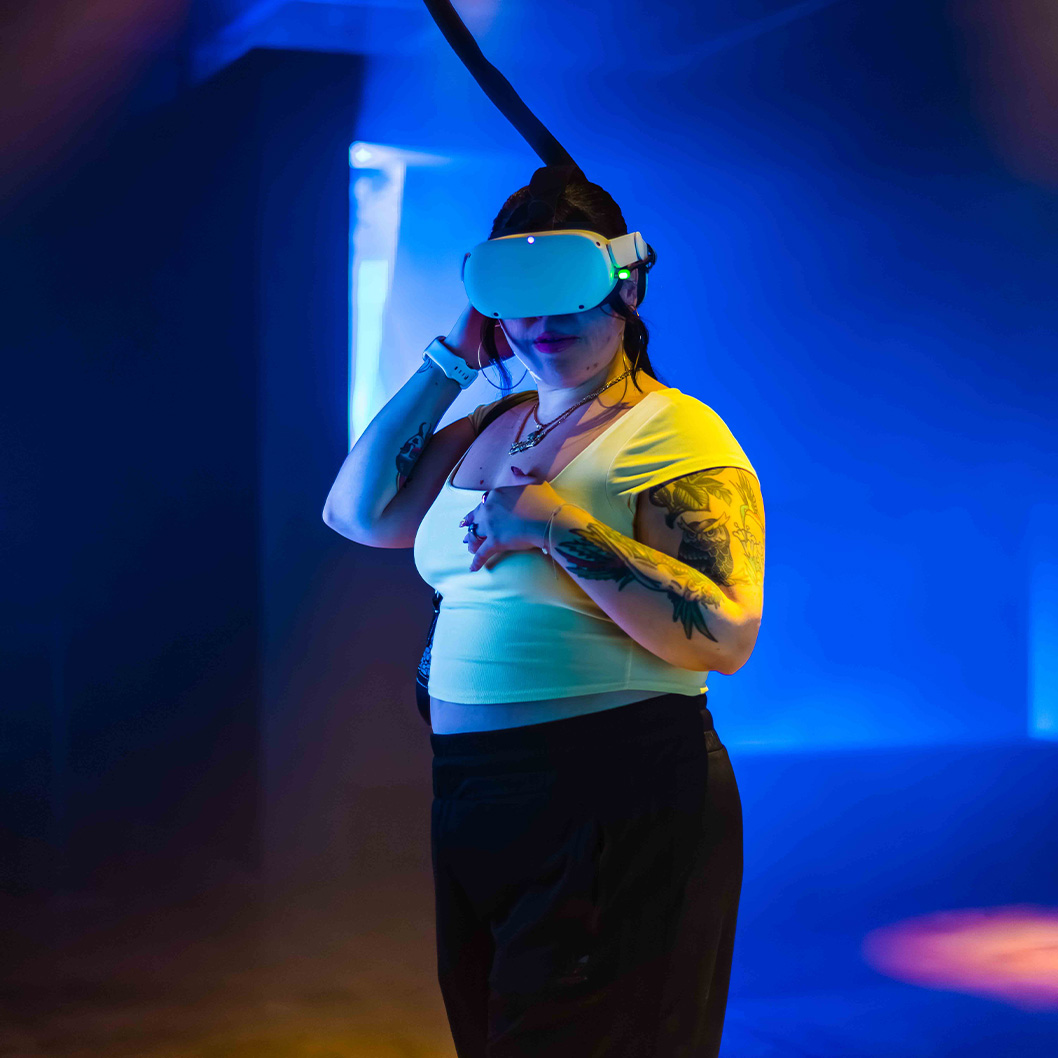
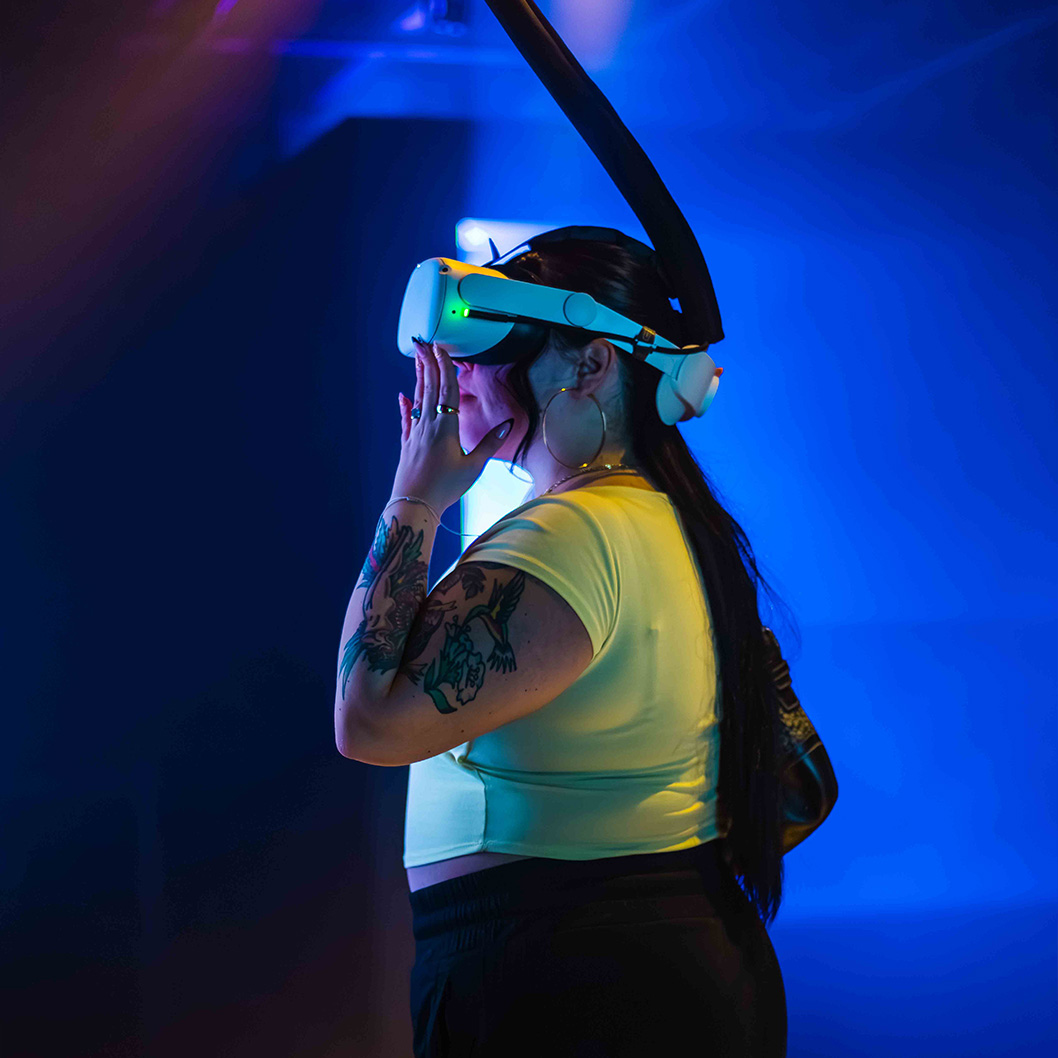
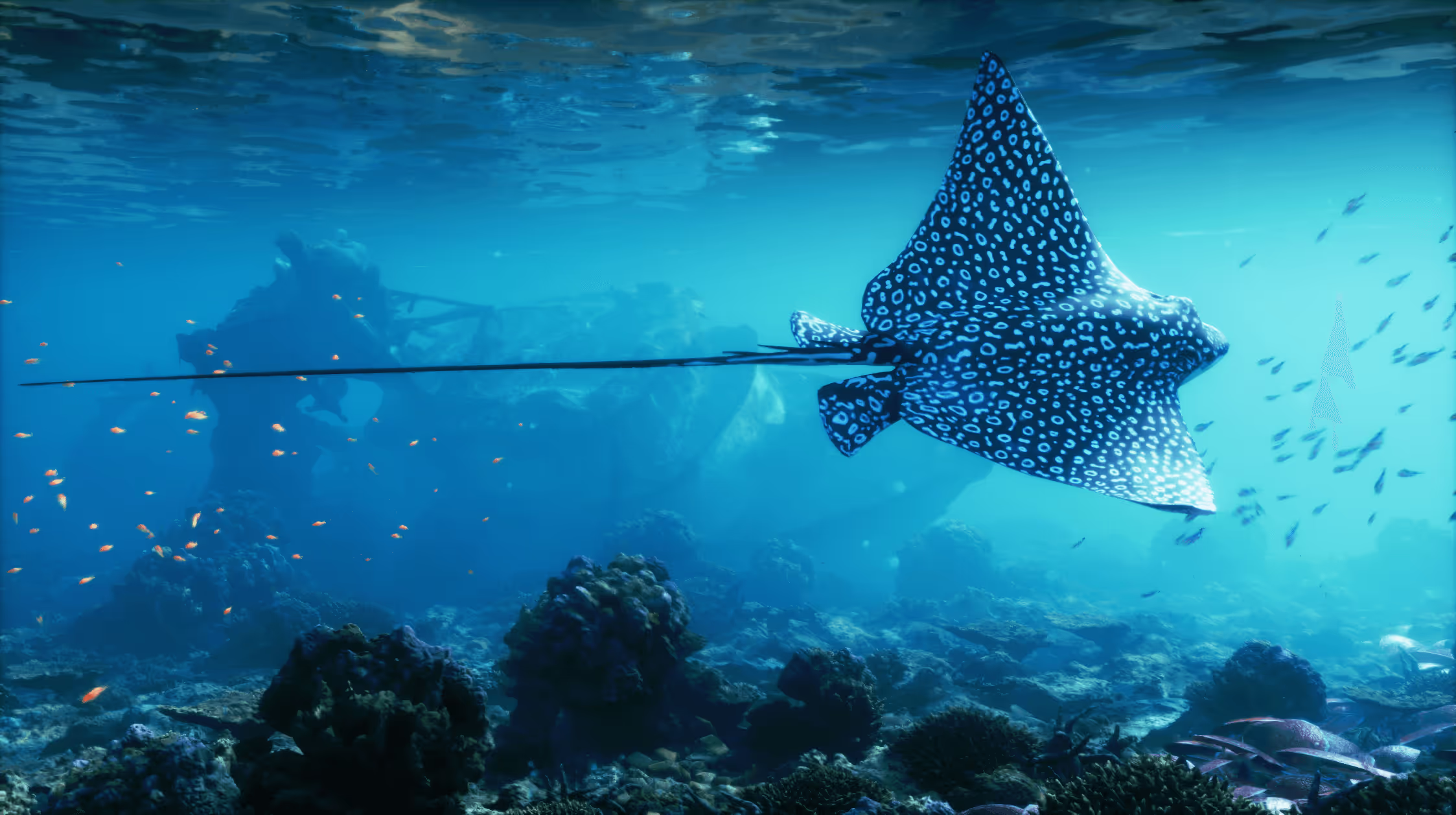
In Search of Light 2, an immersive VR and laser sculpture exhibition, represents a mythic VR cosmology of light and consciousness, unfolding from chaos to post-human transcendence.

 “We are the lamps that burn ourselves to see.”

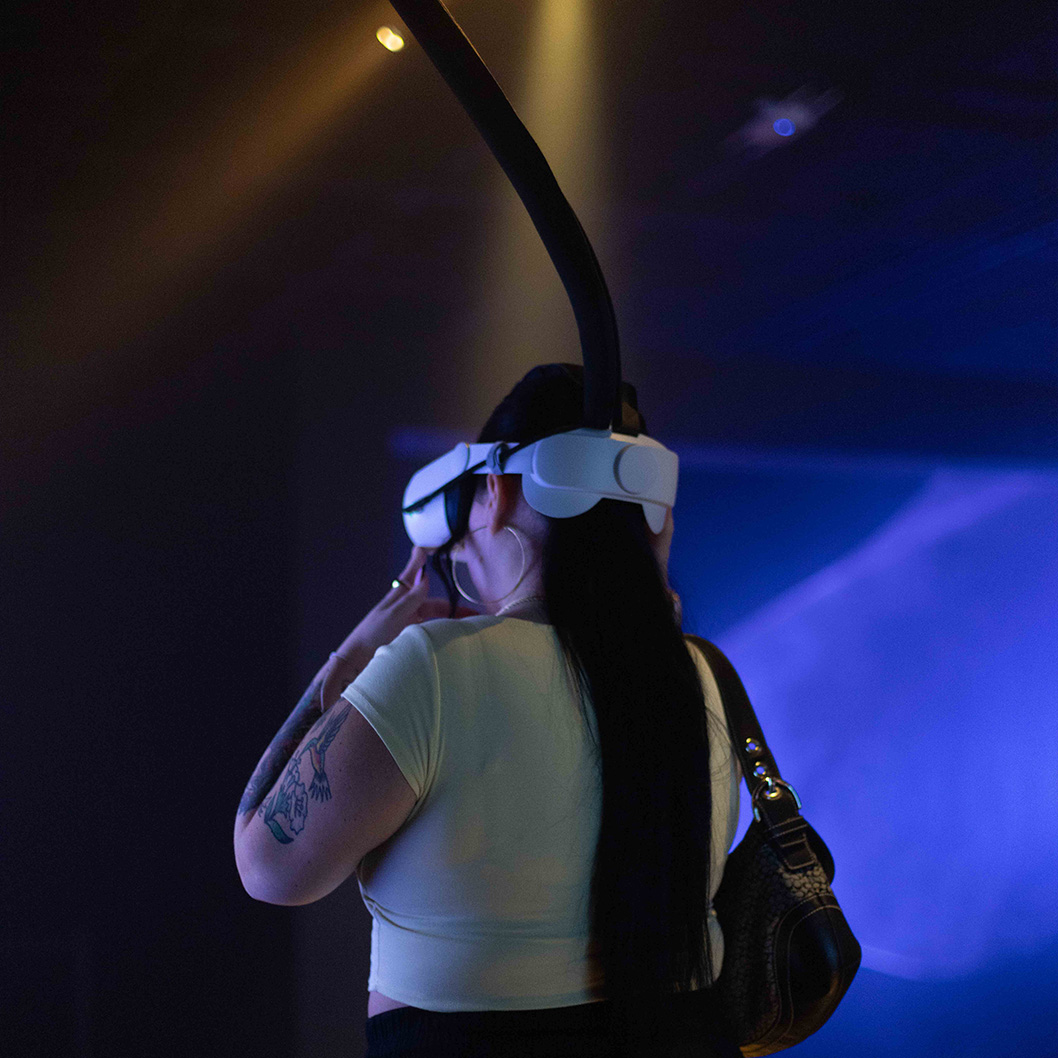
In Search of Light 2 is a large-scale immersive installation that explores humanity’s evolving relationship with light, from primordial darkness to the post-human glow of digital consciousness. The exhibition features a major laser-based light sculpture at its center and a constellation of VR headsets, each containing a journey that guides viewers through the philosophical, spiritual, and technological history of humans and light.

Artist Bio

Miguel Gonzalez, MFA, is a contemporary artist and professor from Venezuela and the USA. Gonzalez graduated from The Parsons School of Design in New York City. He teaches Art and Technology at the New World School of the Arts in Miami. He is a recipient of the Miami-Dade Individual Artists (MIA) Grant Program. He is the creator of Immersive Design Studio “Origen Lux.” His main interests are new media and technology, sound art, language, 3D Animation, and multi-sensorial art spaces.

Miguel Gonzalez

Other Installations

Echoes of sys|calls
By
Jaime Reyes + Erik Natanael

Echoes of sys|calls expands on the conceptual foundation of the earlier sys|calls project, evolving it into a spatial, time-based installation that foregrounds the underlying structures of computation. Presented as a 10-minute audiovisual environment, the work translates digital processes into a large-scale, floor-based projection covering the full surface of a basketball court.

Rather than depicting the full density of system activity, the installation focuses on its essential qualities — rhythm, repetition, and internal pulse. The visuals form a continuous field of motion that makes computational behaviour legible as spatial choreography. This is supported by a curated multi-channel sound composition, mixed and mastered to highlight the tonal and structural characteristics of computational processes without overwhelming the visitor.

A key development in this iteration is the integration of subtle, highly curated interactivity. The system responds to visitors’ presence in minimal but perceptible ways, allowing movement within the court to gently influence the audiovisual environment. These responses are intentionally restrained, offering a sense of agency while maintaining the contemplative nature of the work.

Echoes of sys|calls positions computation as a sensory landscape rather than an abstract operation. Through reduction, spatial expansion, and carefully choreographed responsiveness, the work invites audiences to encounter software as an active but quiet presence — one that both contains and reacts to the bodies moving within it.

Fort Lauderdale
Pace
By
Ana María Caballero

In her most recent micro-poetic film, Ana María Caballero pays homage to Pipilotti Rist’s Ever Is Over All and proposes an evolution in personal empowerment. Whereas Rist’s protagonist symbolically takes down failed systems, Caballero’s main character practices radical repair.

Pace posits that private joy is as powerful a form of resistance as destruction. Caballero stars in her own work, performing gleeful movements rooted in Latin American salsa music, which she grew up dancing and accesses as a source of resilience. As she advances, urban wreckage repairs.

By contrast, in Rist’s work, a woman smashes car windows with a flower as she walks down a street, an exuberant smile on her face, similar to the smile she’s given by a passing policewoman, who presumably approves of the destruction.

The works are connected through the protagonists’ outward and exaggerated expressions of self-possessed joy and their public (and thus out-of-place) physicality. Both works are also linked through the protagonists’ red shoes, signaling confidence in the trodden path. 

This is the first work from Caballero’s ongoing Literal Litoral series of performative explorations that combines her live, performed poetry with cinematic AI. 

In Pace, Madrid’s Calle del Barquillo is recreated through AI because a pharmacy that bears her father’s name, F. Caballero, exists there in actuality. Caballero pilgrimaged here daily as she mourned her father’s death, finding solace in its presence.

The second part of this multichannel installation consists of coded visuals, the result of a custom algorithm that reads Caballero’s body-in-motion and translates it into graphic marks, ​​probing the connection between embodied experience and our attempts to record it.

We often consider that to encounter nature, we need to go somewhere to do so. But our bodies themselves are nature. Rist’s video pairs gleeful destruction with scenes of out-of-focus flowering scenes. In contrast, Caballero pairs radical repair with the body-as-sign, proposing closer relationships with ourselves as a first approach to systemic transformation.

Dania Beach
Body and Technology
By
Performance in Flux

Body and Technology by Performance in Flux

Performance Artists: Enrique Villacreses, Ibuki Kuramochi, Muu Blanco, Óldo Erréve

Body and Technology examines the interplay between body and technology, featuring live performances and video works by multiple artists, curated and presented by Performance in Flux. The project explores how contemporary bodies transform through encounters with sound, light, video, and devices such as lasers, drones, projectors, and 3D printers, highlighting experimentation, sensory awareness, and movement. This installation includes the following:
Human Performer is a live performance by Ibuki Kuramochi that combines Butoh dance with video projections, exploring physicality and movement while reflecting on Japanese female identity, tradition, and the body through a contemporary, post-human lens.

Tótec/Holomastigot is a live performance/installation by Óldo Erréve that integrates laser light and a 3D printing-based machine as active elements of the work. This work explores the relationship between the human body and technology through real-time interaction between the performer, laser systems, and machine-driven processes, creating a hybrid human-nonhuman environment.

Caribbean Latencies is a live experimental sound performance by Muu Blanco that draws from Afro-Caribbean rhythmic structures and experimental sound practices, activating light, space, and movement to create an immersive sensory environment where sound functions as rhythm, memory, and vibration.

How to Attain Heaven is a live, human-machine interaction performance by Enrique Villacreses in which a human body enters a ritual encounter with a drone. Through choreographed movement, the dancer and the machine engage in a delicate exchange, circling, responding, and mirroring one another, blurring the boundaries between the organic and the technological.

In addition, while the space is not activated by a performance, there will be a series of videos by: David Correa (@daavud), Denise Merlot (@denisemerlot), Enrique Villacreses (@friesh), Georgia b Smith (@georgiab.smith), gustaf broms (@gustafbroms2), Ibuki Kuramochi (@ibuki_kuramochi), Katherina Sadovsky (@sadovskykat), Lihong Bai (@weeds.bai), Muu Blanco (@muublancoartsound), Óldo Erréve (@oldoerreve), Petra (@petra.synthetic), Syncopate Collective (@syncopatecollective), Zack Nguyen (@itszacknguyen)

Dania Beach
Sugar Coated
By
Samantha Salzinger

Sugar Coated constructs a world where desire, nostalgia, and excess crystallize into landscapes both seductive and unsettling. Entirely built by hand — piped, poured, sculpted, and assembled — the environments mimic the glossy perfection of digital renderings, revealing the slippage between the real and the simulated. The result is a hyperreal terrain where childhood fantasies bloom into scenes of slow collapse.

The immersive installation begins with softness: pink, plush carpet underfoot, sweet aromas in the air, clouds of pastel color, and forests made from gumdrops, whipped cream, melted candy, and cereal rubble. At first glance, the settings shimmer with confectionary innocence. Yet each tableau carries a fault line: a chocolate bunny sinking into its own sugary ground; lollipop hearts slumped and bleeding into pools of syrup; extravagant candy forests dissolving under an invisible heat. Even the cereal landscape — bright marshmallows embedded in mounds of processed grain — suggests ecological drift, industrial excess, and the sedimentation of consumer culture.

At the center of the installation is a large-scale video projection, a cyclical, atmospheric work in which these crafted worlds begin to breathe, shift, and decay. Free of dialogue, the video becomes a hypnotic loop of seduction and dissolution, echoing the rhythms of appetite and exhaustion. It evokes the compulsive feedback loops of contemporary life — shopping, scrolling, consuming — where small bursts of dopamine produce temporary pleasure before tipping into overwhelm. In this oscillation between delight and depletion, the landscapes behave like metaphorical nervous systems, forever chasing the next hit of sweetness.

Sugar Coated exposes the hidden cost of manufactured happiness, revealing how desire can curdle into saturation and how pleasure, once mass-produced, becomes a trap. The landscapes are idyllically beautiful, but their beauty is uneasy, always on the verge of collapse. In this tension lies the work’s power: an invitation to wander through a fantasy that is as enchanting as it is impossible to sustain — a mirror held up to the cycles of consumption that define contemporary life: swipe, scroll, buy, discard, repeat.

Dania Beach
Geist
By
Loop

Geist is a new artwork by Loop inspired by the elusive neutrino particle. Neutrinos, in their very nature, are tiny, almost massless particles that are extremely hard to detect but are believed to make up the fabric of the universe. They are believed to have been created by the Big Bang and nuclear reactions inside stars and planets. Neutrinos are omnipresent, and it is thought that billions of them pass through our bodies every second. Particle physicists use mammoth neutrino detectors to hunt and trace these so-called ‘ghost particles.’

Inspired by these enormous neutrino detectors, Geist is our exploration of the complex game of ‘hide and seek’ that scientists play to find and provide evidence for the existence of these particles. Only by hitting mass do these particles become electronically charged and therefore detectable. 

Geist uses a mirror illusion to create a suspended spherical object of light, viewable 360 degrees around the sculpture. The sculpture itself is shaped like an octagonal carousel, 6m in diameter, each of its faces a 3x3m window into a figment of mirror and light. The illusion is interactive; only by the proximity and movement of the public does the suspended sphere of light come to life. Individually addressable LED modules start flickering and glimmering in the presence of people. The public is the cause of the artwork’s existence; their mass emits a response from the artwork: a version of ‘hide and seek.’

Creative coding by Motus Art6

Sound Design by Dan Bibby

Hollywood

Other Installations

Mycelia Prototype Sculpture
By
Daniel Popper

Daniel Popper’s Mycelia Prototype Sculpture is a living symbol of unity and transformation, perfectly aligned with the spirit of Black Rock City — a place where collective imagination becomes reality. Named for the filigreed, thread-like fungus, Mycelia extends reflections on the interconnectedness of humans and the natural world. 

Mushrooms offer themselves as metaphor and image; the strange blooms of an otherwise invisible organism that runs beneath the forest floor. Mycelium is nature’s neurological network, a vast web of fine filaments that transmit electrical signals between plants and fungi. Or rather, in the words of biologist Melvin Sheldrake, “mycelium is ecological connective tissue, the living seam by which much of the world is stitched into relation.” 

Set beneath the trees, the sculpted bust becomes an analogy of mycelia as consciousness, the forest as much alive as the mind. Like thoughts flowering at the edge of awareness, mushrooms mark the outer reaches of a mycelium’s breadth. Having bloomed, they soon decay, leaving the soil all the more fertile that new filigrees might extend, and consciousness expands. Mycelia reminds the viewer that the thinking mind is a part of nature, indivisible from it. There is no duality between human and plant; both are a part of a complex, entangled whole.

FLL Airport
Echoes of sys|calls
By
Jaime Reyes + Erik Natanael

Echoes of sys|calls expands on the conceptual foundation of the earlier sys|calls project, evolving it into a spatial, time-based installation that foregrounds the underlying structures of computation. Presented as a 10-minute audiovisual environment, the work translates digital processes into a large-scale, floor-based projection covering the full surface of a basketball court.

Rather than depicting the full density of system activity, the installation focuses on its essential qualities — rhythm, repetition, and internal pulse. The visuals form a continuous field of motion that makes computational behaviour legible as spatial choreography. This is supported by a curated multi-channel sound composition, mixed and mastered to highlight the tonal and structural characteristics of computational processes without overwhelming the visitor.

A key development in this iteration is the integration of subtle, highly curated interactivity. The system responds to visitors’ presence in minimal but perceptible ways, allowing movement within the court to gently influence the audiovisual environment. These responses are intentionally restrained, offering a sense of agency while maintaining the contemplative nature of the work.

Echoes of sys|calls positions computation as a sensory landscape rather than an abstract operation. Through reduction, spatial expansion, and carefully choreographed responsiveness, the work invites audiences to encounter software as an active but quiet presence — one that both contains and reacts to the bodies moving within it.

Fort Lauderdale
Pace
By
Ana María Caballero

In her most recent micro-poetic film, Ana María Caballero pays homage to Pipilotti Rist’s Ever Is Over All and proposes an evolution in personal empowerment. Whereas Rist’s protagonist symbolically takes down failed systems, Caballero’s main character practices radical repair.

Pace posits that private joy is as powerful a form of resistance as destruction. Caballero stars in her own work, performing gleeful movements rooted in Latin American salsa music, which she grew up dancing and accesses as a source of resilience. As she advances, urban wreckage repairs.

By contrast, in Rist’s work, a woman smashes car windows with a flower as she walks down a street, an exuberant smile on her face, similar to the smile she’s given by a passing policewoman, who presumably approves of the destruction.

The works are connected through the protagonists’ outward and exaggerated expressions of self-possessed joy and their public (and thus out-of-place) physicality. Both works are also linked through the protagonists’ red shoes, signaling confidence in the trodden path. 

This is the first work from Caballero’s ongoing Literal Litoral series of performative explorations that combines her live, performed poetry with cinematic AI. 

In Pace, Madrid’s Calle del Barquillo is recreated through AI because a pharmacy that bears her father’s name, F. Caballero, exists there in actuality. Caballero pilgrimaged here daily as she mourned her father’s death, finding solace in its presence.

The second part of this multichannel installation consists of coded visuals, the result of a custom algorithm that reads Caballero’s body-in-motion and translates it into graphic marks, ​​probing the connection between embodied experience and our attempts to record it.

We often consider that to encounter nature, we need to go somewhere to do so. But our bodies themselves are nature. Rist’s video pairs gleeful destruction with scenes of out-of-focus flowering scenes. In contrast, Caballero pairs radical repair with the body-as-sign, proposing closer relationships with ourselves as a first approach to systemic transformation.

Dania Beach
Body and Technology
By
Performance in Flux

Body and Technology by Performance in Flux

Performance Artists: Enrique Villacreses, Ibuki Kuramochi, Muu Blanco, Óldo Erréve

Body and Technology examines the interplay between body and technology, featuring live performances and video works by multiple artists, curated and presented by Performance in Flux. The project explores how contemporary bodies transform through encounters with sound, light, video, and devices such as lasers, drones, projectors, and 3D printers, highlighting experimentation, sensory awareness, and movement. This installation includes the following:
Human Performer is a live performance by Ibuki Kuramochi that combines Butoh dance with video projections, exploring physicality and movement while reflecting on Japanese female identity, tradition, and the body through a contemporary, post-human lens.

Tótec/Holomastigot is a live performance/installation by Óldo Erréve that integrates laser light and a 3D printing-based machine as active elements of the work. This work explores the relationship between the human body and technology through real-time interaction between the performer, laser systems, and machine-driven processes, creating a hybrid human-nonhuman environment.

Caribbean Latencies is a live experimental sound performance by Muu Blanco that draws from Afro-Caribbean rhythmic structures and experimental sound practices, activating light, space, and movement to create an immersive sensory environment where sound functions as rhythm, memory, and vibration.

How to Attain Heaven is a live, human-machine interaction performance by Enrique Villacreses in which a human body enters a ritual encounter with a drone. Through choreographed movement, the dancer and the machine engage in a delicate exchange, circling, responding, and mirroring one another, blurring the boundaries between the organic and the technological.

In addition, while the space is not activated by a performance, there will be a series of videos by: David Correa (@daavud), Denise Merlot (@denisemerlot), Enrique Villacreses (@friesh), Georgia b Smith (@georgiab.smith), gustaf broms (@gustafbroms2), Ibuki Kuramochi (@ibuki_kuramochi), Katherina Sadovsky (@sadovskykat), Lihong Bai (@weeds.bai), Muu Blanco (@muublancoartsound), Óldo Erréve (@oldoerreve), Petra (@petra.synthetic), Syncopate Collective (@syncopatecollective), Zack Nguyen (@itszacknguyen)

Dania Beach
Sugar Coated
By
Samantha Salzinger

Sugar Coated constructs a world where desire, nostalgia, and excess crystallize into landscapes both seductive and unsettling. Entirely built by hand — piped, poured, sculpted, and assembled — the environments mimic the glossy perfection of digital renderings, revealing the slippage between the real and the simulated. The result is a hyperreal terrain where childhood fantasies bloom into scenes of slow collapse.

The immersive installation begins with softness: pink, plush carpet underfoot, sweet aromas in the air, clouds of pastel color, and forests made from gumdrops, whipped cream, melted candy, and cereal rubble. At first glance, the settings shimmer with confectionary innocence. Yet each tableau carries a fault line: a chocolate bunny sinking into its own sugary ground; lollipop hearts slumped and bleeding into pools of syrup; extravagant candy forests dissolving under an invisible heat. Even the cereal landscape — bright marshmallows embedded in mounds of processed grain — suggests ecological drift, industrial excess, and the sedimentation of consumer culture.

At the center of the installation is a large-scale video projection, a cyclical, atmospheric work in which these crafted worlds begin to breathe, shift, and decay. Free of dialogue, the video becomes a hypnotic loop of seduction and dissolution, echoing the rhythms of appetite and exhaustion. It evokes the compulsive feedback loops of contemporary life — shopping, scrolling, consuming — where small bursts of dopamine produce temporary pleasure before tipping into overwhelm. In this oscillation between delight and depletion, the landscapes behave like metaphorical nervous systems, forever chasing the next hit of sweetness.

Sugar Coated exposes the hidden cost of manufactured happiness, revealing how desire can curdle into saturation and how pleasure, once mass-produced, becomes a trap. The landscapes are idyllically beautiful, but their beauty is uneasy, always on the verge of collapse. In this tension lies the work’s power: an invitation to wander through a fantasy that is as enchanting as it is impossible to sustain — a mirror held up to the cycles of consumption that define contemporary life: swipe, scroll, buy, discard, repeat.

Dania Beach
Geist
By
Loop

Geist is a new artwork by Loop inspired by the elusive neutrino particle. Neutrinos, in their very nature, are tiny, almost massless particles that are extremely hard to detect but are believed to make up the fabric of the universe. They are believed to have been created by the Big Bang and nuclear reactions inside stars and planets. Neutrinos are omnipresent, and it is thought that billions of them pass through our bodies every second. Particle physicists use mammoth neutrino detectors to hunt and trace these so-called ‘ghost particles.’

Inspired by these enormous neutrino detectors, Geist is our exploration of the complex game of ‘hide and seek’ that scientists play to find and provide evidence for the existence of these particles. Only by hitting mass do these particles become electronically charged and therefore detectable. 

Geist uses a mirror illusion to create a suspended spherical object of light, viewable 360 degrees around the sculpture. The sculpture itself is shaped like an octagonal carousel, 6m in diameter, each of its faces a 3x3m window into a figment of mirror and light. The illusion is interactive; only by the proximity and movement of the public does the suspended sphere of light come to life. Individually addressable LED modules start flickering and glimmering in the presence of people. The public is the cause of the artwork’s existence; their mass emits a response from the artwork: a version of ‘hide and seek.’

Creative coding by Motus Art6

Sound Design by Dan Bibby

Hollywood